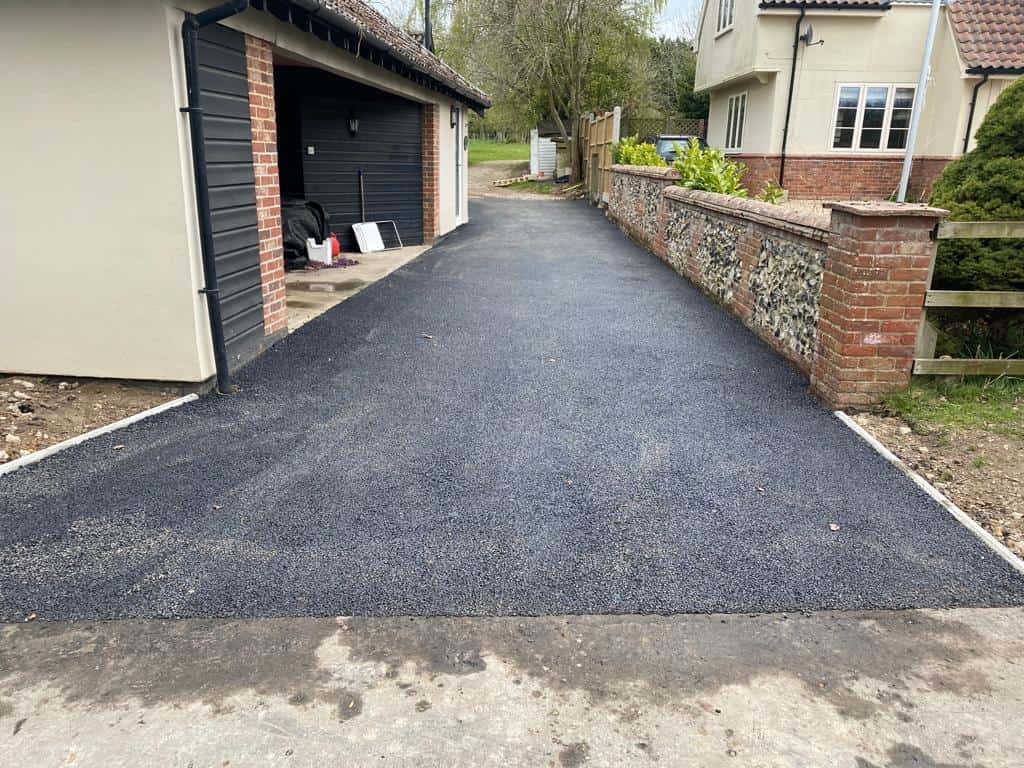
Can Tar & Chip Be Used for Driveways, Paths and Patios Around the Same Property?
Using one surfacing material across several outdoor areas can give a property a more consistent and organised appearance. Tar and chip is commonly associated with driveways and access routes, but it can also be used for paths and certain patio areas when the design, groundwork and intended use are carefully considered.
For properties in Attleborough, Norfolk, tar and chip can provide a practical way to connect different parts of an outdoor space. Its textured finish works particularly well where a natural-looking surface is preferred over a highly uniform or decorative appearance.
Using Tar and Chip Across Different Areas of a Property
Tar and chip is created by applying hot bitumen to a prepared base before covering it with selected stone chippings. The chippings are rolled into the binder, producing a durable surface with visible aggregate and a lightly textured finish.
Although the same basic method can be used for driveways, paths and patios, each area has different requirements. Vehicle weight, pedestrian comfort, drainage and surrounding features must all be considered before installation.
Tar and Chip for Driveways
Driveways must withstand repeated vehicle movements, turning forces and stationary loads. A successful tar-and-chip driveway therefore depends on a stable, properly prepared base.
The finished surface offers useful grip and suits properties where a less formal appearance is desired. The choice of aggregate can also help the driveway complement the surrounding garden and exterior of the property.
Particular attention should be given to areas where vehicles turn, brake or regularly follow the same route. Correct preparation and application help prevent surface movement and premature deterioration in these frequently used sections.
Tar and Chip for Garden Paths
Tar and chip can create clearly defined pedestrian routes between entrances, parking areas, gardens and outbuildings. Using the same aggregate as the driveway allows these paths to feel like part of one coordinated landscape.
Paths still require proper groundwork, even though they do not carry vehicles. An unsuitable base can lead to settlement, uneven sections and water collecting on the surface. The route should also be planned with comfortable widths, sensible gradients and effective drainage.
Because tar and chip has a textured finish, the size and type of stone should be selected carefully for pedestrian areas. A suitable aggregate can provide grip without making the path unnecessarily coarse underfoot.
Tar and Chip for Patio Areas
Tar and chip may be suitable for patios designed primarily as practical outdoor seating or access spaces. It can work especially well where the patio forms part of a larger surfaced area or connects directly to matching paths.
However, the intended use must guide the design. Garden furniture requires a reasonably level and stable surface, while dining spaces should be comfortable to walk across. The chosen chippings, finish and gradients should therefore suit regular pedestrian use rather than simply copying the specification of a vehicle driveway.
It is also important to consider the style of patio required. Tar and chip provides a functional, naturally textured appearance. Homeowners seeking precise paving patterns or a completely smooth finish may prefer another material.
Creating a Consistent Appearance
One of the main benefits of using tar and chip across several areas is visual continuity. A matching aggregate can connect the driveway, paths and patio without making each surface appear unrelated.
Consistency does not mean that every area must be identical. Different edging details, widths and layouts can define each space while the shared surface material ties them together. For example, a broad driveway can transition into narrower paths before opening into a clearly shaped patio.
Careful planning is important at these transition points. Levels should meet neatly, water should move away from buildings, and the routes should remain easy to follow.
Ground Preparation Remains Essential
Tar and chip should not be treated as a covering that can conceal a weak or uneven surface. Its performance depends heavily on the condition of the foundation beneath it.
Preparation may involve:
- Removing unstable or unsuitable material
- Establishing the correct depth and profile
- Installing and compacting an appropriate sub-base
- Creating suitable gradients for water run-off
- Strengthening areas exposed to vehicle traffic
- Forming secure edges to contain the surface
- Ensuring adjoining levels meet correctly
The amount of preparation may vary between the driveway, paths and patio. A driveway usually requires greater load-bearing strength, while pedestrian spaces need particular attention to comfort, levels and drainage.
Drainage Must Be Planned as a Whole
Surfacing several connected areas can alter how water moves around a property. The driveway, paths and patio should therefore be planned together rather than considered as separate installations.
Poorly positioned falls can direct water towards entrances, walls or low sections of the garden. Suitable gradients and drainage details help move surface water away from vulnerable areas and reduce the likelihood of standing water.
A coordinated plan is particularly valuable where paths link directly to a driveway or patio, as water may otherwise travel from one surface onto another.
Is Tar and Chip Suitable for Every Area?
The material can be highly effective, but suitability depends on how each space will be used. It may be less appropriate where an exceptionally smooth surface is needed, intricate decorative patterns are required or lightweight furniture must remain perfectly stable.
A professional assessment can identify whether tar and chip will perform well throughout the property or whether combining it with another complementary surface would produce a better result.
Conclusion
Tar and chip can be used for driveways, paths and patios around the same property, creating a practical and visually consistent outdoor layout. Its success depends on designing each area for its specific purpose, preparing the foundations correctly and planning levels, edging and drainage as one complete scheme.
Attleborough Driveway Services provides professional tar-and-chip surfacing in Attleborough, Norfolk. If you are considering resurfacing several areas around your property, contact our team to discuss whether tar and chip is suitable for your driveway, paths and patio.
Call us on: 01953 660 780
Click here to find out more about Attleborough Driveway Services
Click here to complete our contact form and see how we can help with your driveway needs.